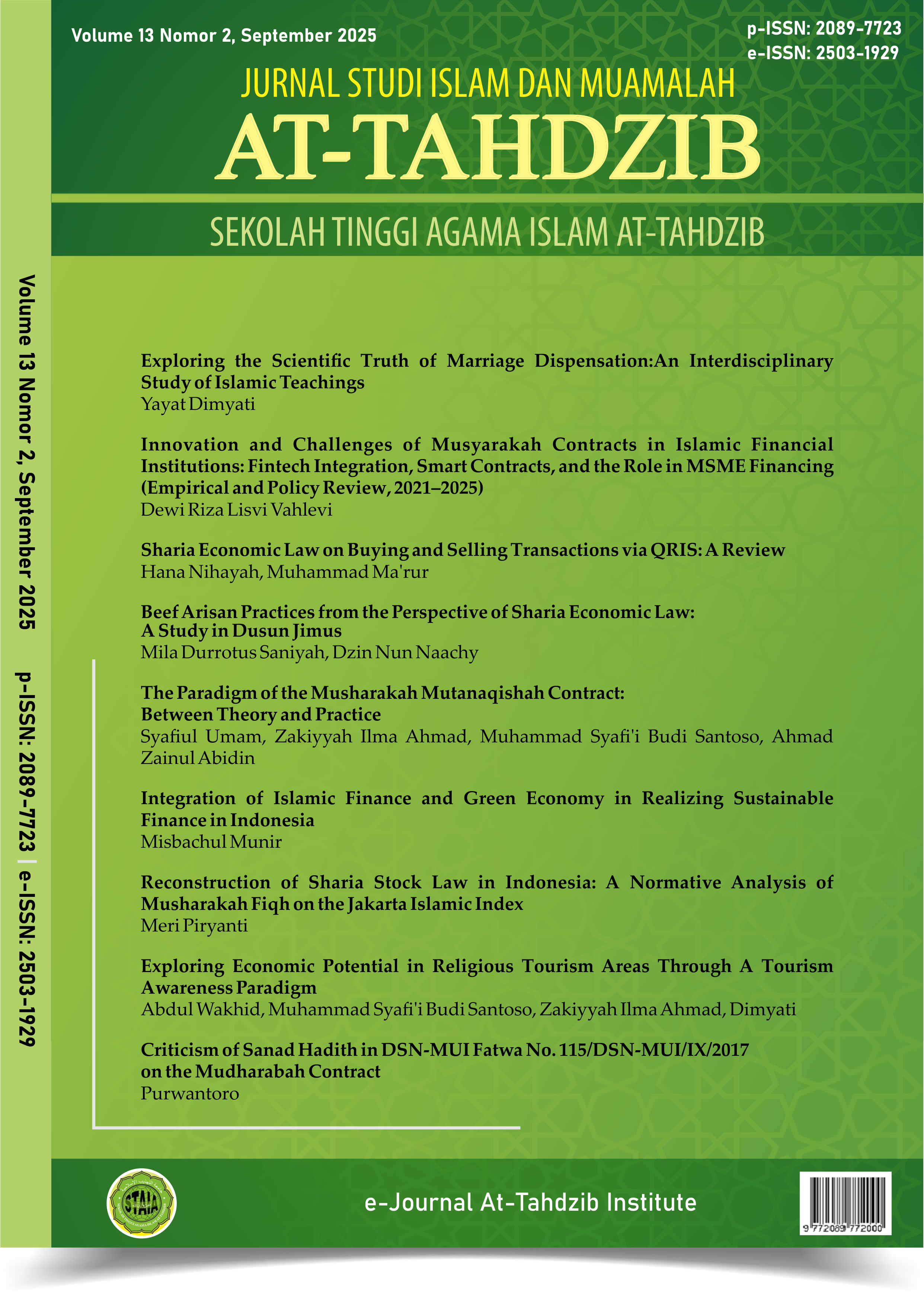
Sharia Economic Law on Buying and Selling Transactions via QRIS: A Review
DOI:
https://doi.org/10.61181/whkb2b46Keywords:
QRIS, Buying and Selling Transactions, Islamic Economic Law, Digital PaymentAbstract
Background. The rapid development of digital payment systems has significantly transformed buying and selling transactions in Indonesia, particularly through the implementation of the Quick Response Code Indonesian Standard (QRIS). Although QRIS is widely adopted by micro and small business actors due to its efficiency and practicality, studies examining its compliance with Islamic economic law remain limited. This condition raises important questions regarding the validity of contracts, transparency of transactions, and the potential presence of prohibited elements such as riba, gharar, and maysir within digital payment mechanisms. Aim. This article aims to analyze the practice of buying and selling transactions using QRIS and to examine their conformity with the principles of Islamic economic law, focusing on the legality of the transaction mechanism and its adherence to sharia principles. Methods. This study employs a qualitative research method with a case study approach. Data were collected through observations, in-depth interviews with merchants and consumers, and documentation in Rejoagung Village, Jombang Regency. The data were analyzed descriptively using the theoretical framework of Islamic economic law. Results. The findings indicate that QRIS-based transactions generally fulfill essential elements of valid transactions, including mutual consent, clarity of transaction objects, and certainty of payment. From the perspective of Islamic economic law, buying and selling transactions using QRIS are permissible as long as they do not involve elements of riba, gharar, or maysir, and uphold principles of justice, transparency, and accountability. Therefore, QRIS can be considered a legitimate payment instrument in Islamic commercial transactions, provided that sharia principles are consistently observed.
References
Affero, M. I. “Dinamika Konsep Gharar dalam Transaksi Keuangan.” Mal (Jurnal Fakultas Syariah), 2024.
Ali, Muhammad Daud. Pengantar Hukum Islam. Jakarta: RajaGrafindo Persada, 2016.
Bank Indonesia. Blueprint Sistem Pembayaran Indonesia 2025. Jakarta: Bank Indonesia, 2019.
Bungin, Burhan. Metodologi Penelitian Sosial. Jakarta: Kencana, 2015.
Dewan Syariah Nasional–Majelis Ulama Indonesia. Fatwa No. 02/DSN-MUI/IV/2000 tentang Tabungan. Jakarta: DSN-MUI, 2000.
Idris, M., Ambok Pangiuk, dan Ahsan Putra Hafiz. “Model Arisan Sembako: Tinjauan Fiqh dan Ekonomi.” IJIEB: Indonesian Journal of Islamic Economics and Business 5, no. 2 (2021).
Khom, Ahmad Mufah. Tinjauan Maqāṣid Syariah pada Arisan Kue Hari Raya dan Sembako. Skripsi. Surabaya: UIN Sunan Ampel, 2022.
Miles, Matthew B., dan A. Michael Huberman. Qualitative Data Analysis. London: Sage Publications, 2014.
Moleong, Lexy J. Metodologi Penelitian Kualitatif. Bandung: PT Remaja Rosdakarya, 2017.
Mujahidin, Akhmad. Hukum Perbankan Syariah. Jakarta: PT RajaGrafindo Persada, 2016.
Otoritas Jasa Keuangan. Literasi Keuangan Digital. Jakarta: OJK, 2020.
Rahmawati, Safira, dan Istianah. “Transformasi Arisan dalam Perspektif Hukum Ekonomi Syariah.” Jurnal Hukum Ekonomi Syariah 5, no. 2 (2022).
Rohidin. Pengantar Hukum Islam. Yogyakarta: Lintang Rasi Aksara, 2016.
Sugiyono. Metode Penelitian Kualitatif. Bandung: Alfabeta, 2020.
az-Zuhaili, Wahbah. Al-Fiqh al-Islāmī wa Adillatuh. Damaskus: Dār al-Fikr, 2007.
az-Zuhaili, Wahbah. Fiqh al-Islāmī wa Adillatuh. Damaskus: Dār al-Fikr, 1985.
Downloads
Published
Issue
Section
License
Copyright (c) 2026 Hana Nihayah, Muhammad Ma'rur

This work is licensed under a Creative Commons Attribution 4.0 International License.