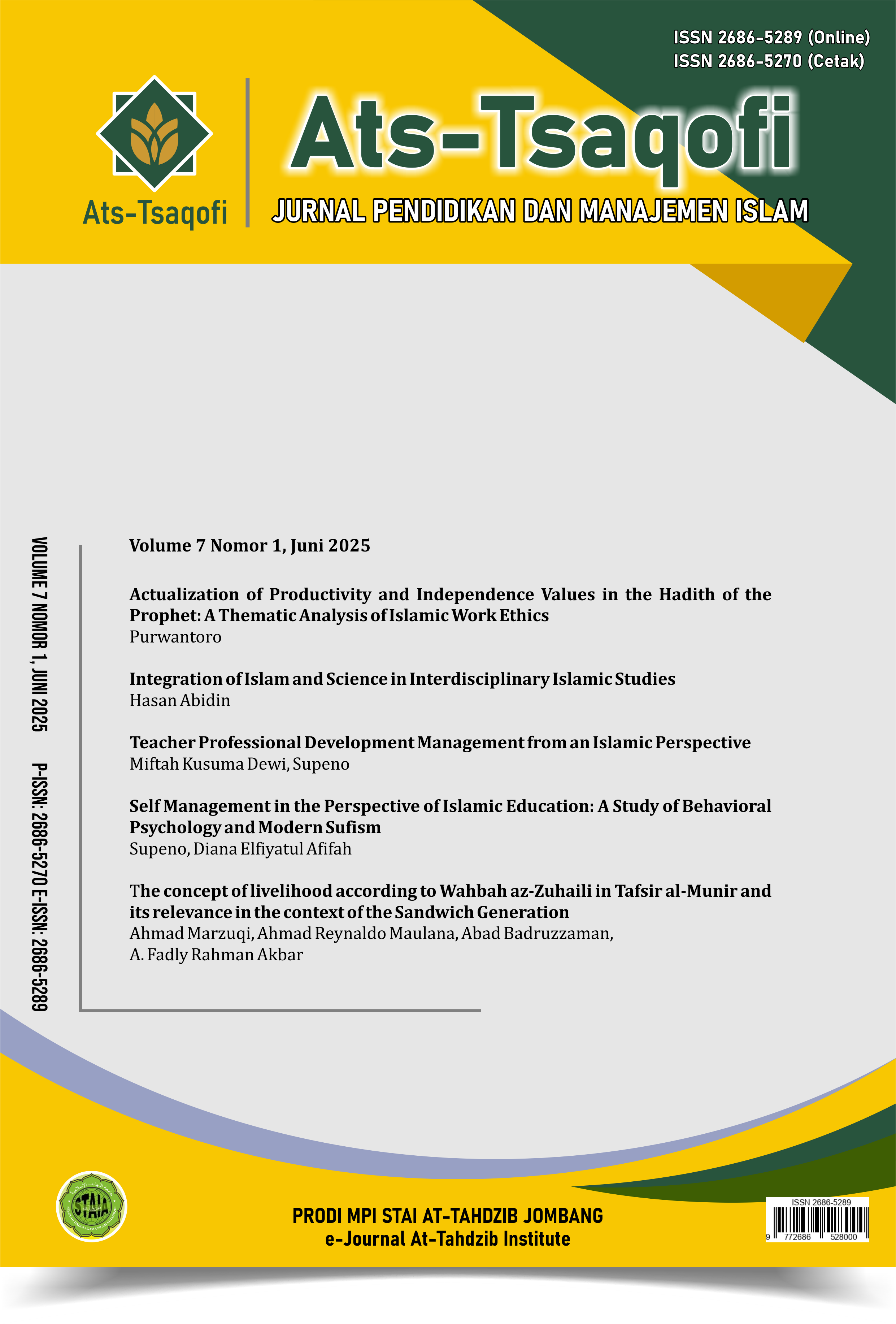
Teacher Professional Development Management from an Islamic Perspective
DOI:
https://doi.org/10.61181/zd9hx139Keywords:
Management, Teacher Professionalism, Development, Islamic Education, Islamic PerspectiveAbstract
Teacher professionalism is a major factor in educational success, as teachers serve not only as transmitters of knowledge but also as moral and spiritual role models for students. In the context of Islamic education, teacher professional development must be based on Islamic values that emphasize a balance between intellectual, moral, and spiritual competencies. This study uses a literature study method with a descriptive-analytical approach to analyze the concept and implementation of teacher professional development management from an Islamic perspective as well as Islamic managerial principles relevant to educational institutions. The results of the study indicate that teacher professional development management in Islam includes four main functions: planning (takhṭīṭ), organizing (tanẓīm), directing (tawjīh), and supervising (raqabah), which are oriented towards moral development, competency improvement, and the refinement of intentions and work ethics. Teacher professionalism is not only measured from pedagogical and professional aspects, but also from sincerity, trustworthiness, and noble character in carrying out duties. By implementing Islamic management based on the values of monotheism, continuous development, and a work culture modeled after the Prophet Muhammad (peace be upon him), teachers can develop into competent individuals with noble character, and make their profession a form of devotion and worship to Allah Swt. These findings are expected to serve as a basis for Islamic educational institutions in designing comprehensive, sustainable, and spiritually oriented teacher development strategies.
References
Ibnudin & Syatori, “Professionalism of Islamic Religious Education Teachers,” Al-Fadlan: Journal of Islamic Education and Teaching, 1(1) (2023): 24-30
Debrianti, Auliah; Ismail Abdussabir, Ahmad; Rosdiana, “Profesionalitas Guru dalam Proses Kegiatan Belajar Mengajar: Teacher Professionalism in the Teaching and Learning Process,” ISEDU: Islamic Education Journal, 2(1) (2024): 64-69
Nurdiyanto, N., Thoriqul Islam, M., Marjany, N., Maslani, & Hasbiyallah, “Issues of Professionality and Competency of Islamic Religious Education Teachers in Facing the Society 5.0 Era,” Cendekia: Jurnal Kependidikan dan Kemasyarakatan, 22(1) (2025)
Sholeh, M. I., Sokip; Syafi’i, A.; Habibulloh, M.; Nur’azah; Nashihuddin, M.; Al Farisy, F.; Sahri; Munif, “Application of Islamic-based Management Principles for Improving Teacher Professionalism,” JPEM: Journal of Perspectives on Educational Management, 1(1) (2025): 1-12
Abudin Nata. Manajemen Pendidikan Islam (Jakarta: RajaGrafindo Persada, 2021), 57.
Ibnudin & Syatori, “Professionalism of Islamic Religious Education Teachers,” Al-Fadlan: Journal of Islamic Education and Teaching 1(1) (2023): 24–30.
Rasyid, M. A., Etika Profesi Guru dalam Perspektif Islam (Yogyakarta: Deepublish, 2022), 63
Kusnadi & Mulyadi, “Manajemen Pendidikan Islam dalam Pengembangan Profesionalisme Guru,” Tadbir: Jurnal Manajemen Pendidikan Islam 7(2) (2023): 112–121
Nurdiyanto, N., Thoriqul Islam, M., et al., “Issues of Professionality and Competency of Islamic Religious Education Teachers in Facing the Society 5.0 Era,” Cendekia: Jurnal Kependidikan dan Kemasyarakatan 22(1) (2025).
Quraish Shihab, Wawasan Al-Qur’an: Tafsir Maudhu’i atas Pelbagai Persoalan Umat (Bandung: Mizan, 2018), 208.
Hamzah, A. (2021). Manajemen Pendidikan Islam dalam Perspektif Integratif-Transformatif. Jurnal Manajemen Pendidikan Islam, 7(2), 115–127.
Alim, M. (2020). Konsep Manajemen Islami dalam Pengembangan SDM Pendidikan. Jurnal Ta’dibuna, 9(1), 55–66.
Nurdin, M., & Sari, F. (2022). Perencanaan Pengembangan Kompetensi Guru Berbasis Nilai Islam. Jurnal Tarbiyah Islamiyah, 6(2), 88–97.
Syafii, M. (2020). Konsep Tanẓīm dalam Manajemen Pendidikan Islam. Jurnal Ta’dib, 25(1), 77–86.
Fahri, M. (2022). Peran Kepala Sekolah sebagai Motivator dalam Perspektif Islam. Jurnal Manajemen Pendidikan Islam, 10(1), 77–89.
Yusuf, A. (2023). Nilai Motivasi Qur’ani dalam Profesionalisme Guru. Jurnal At-Tarbawi, 8(1), 34–46.
Nurdiyansyah, I. (2021). Raqabah sebagai Prinsip Pengawasan Islami. Jurnal Pendidikan Islam, 7(3), 219–228.
Aziz, M. (2022). Supervisi Akademik dan Spiritual dalam Pendidikan Islam. Jurnal Tarbiyatuna, 10(2), 91–104.
Rahman, H. (2023). Etika Profesi Guru dalam Perspektif Islam. Jurnal Pendidikan Islam, 9(1), 45–57.
arahap, M. (2024). Integrasi Nilai Religius dalam Manajemen Kinerja Guru. Jurnal Pendidikan Islam Kontemporer, 12(1), 19–32
Syamsudin, S. (2020). Pembinaan Spiritual Guru melalui Kegiatan Keagamaan di Sekolah Islam. Jurnal Edukasi Islam, 4(2), 102–113.
Zainuddin, A. (2022). Profesionalisme Guru dalam Perspektif Akhlak Islam. Jurnal Ta’dibiyah, 9(3), 189–203.
Downloads
Published
Issue
Section
License
Copyright (c) 2025 Miftah Kusuma Dewi, Supeno

This work is licensed under a Creative Commons Attribution-ShareAlike 4.0 International License.