
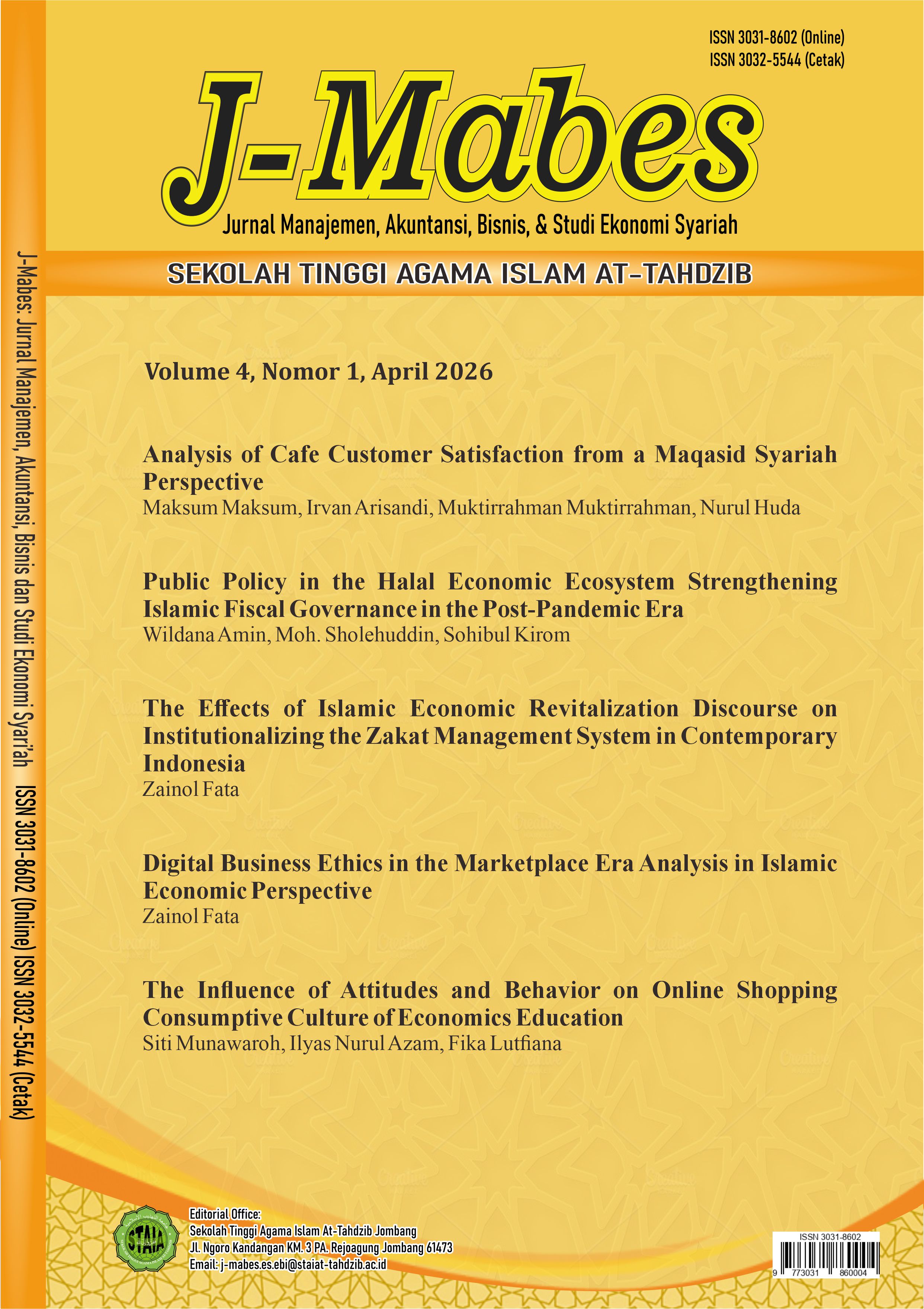
Digital Business Ethics in the Marketplace Era Analysis in Islamic Economic Perspective
DOI:
https://doi.org/10.61181/j-mabes.v2i2.611Keywords:
Digital Business Ethics, Marketplace, Islamic EconomicsAbstract
The rapid development of digital technology has significantly transformed economic and business activities. This transformation has driven efficiency, innovation, and the expansion of market reach through marketplace platforms. Transactions that were previously conducted conventionally have now shifted to more flexible digital systems without limitations of space and time. Marketplaces also provide substantial opportunities for businesses, particularly SMEs, to grow. However, behind this convenience, various ethical issues have emerged, such as review manipulation, discrepancies in product information, lack of price transparency, and the presence of information asymmetry.
This study aims to analyze the importance of implementing digital business ethics in marketplaces and its alignment with Islamic economic principles in building trust and business sustainability.
This research employs a literature review approach by examining various sources, including academic journals and books related to digital business ethics and Islamic economics. The analysis is conducted descriptively to understand the phenomena and issues involved.
The findings indicate that digital business ethics plays a crucial role in enhancing consumer trust and loyalty. Values such as honesty (shiddiq), trustworthiness (amanah), justice (adl), and transparency (tabligh) are proven to be key factors in creating healthy business interactions. Moreover, these principles are aligned with Islamic economic values, thereby supporting the development of a fair, transparent, and sustainable marketplace system
Downloads
Downloads
Published
Issue
Section
License
Copyright (c) 2026 Zainol Fata

This work is licensed under a Creative Commons Attribution 4.0 International License.








 Jurnal Manajemen, Akuntansi, Bisnis Dan Studi Ekonomi Syariah